Commercial Kitchen Equipment Best Practices for the Hospitality Industry
From ovens to fryers, choosing the right commercial kitchen equipment can make or break your hospitality operation. Here's everything UK managers need to know.
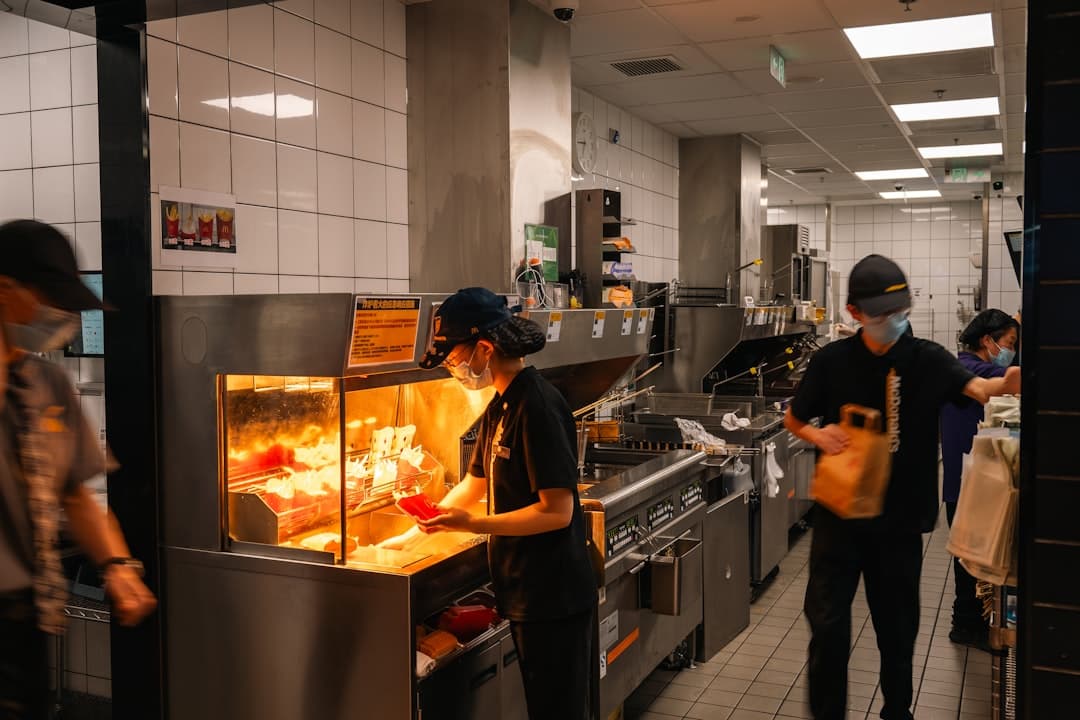 Photo: Photo by Cheng Shi Song on Unsplash
Why Equipment Choice Defines Kitchen Performance
Every dish that leaves your kitchen passes through a chain of equipment decisions made long before service begins. Whether you run a busy city-centre restaurant, a rural gastropub, a hotel with multiple dining outlets, or a contract catering operation, the commercial kitchen equipment you choose directly shapes your food quality, staff efficiency, compliance standing, and bottom line.
This guide cuts through the noise. Rather than listing products, it gives hospitality owners and managers a practical framework for selecting, financing, maintaining, and optimising commercial kitchen equipment - covering the topics that most supplier brochures and generic buying guides quietly skip over.
What Equipment Is Used in a Commercial Kitchen?
Commercial kitchens rely on a wide range of specialised equipment, built to withstand continuous, high-volume use that domestic appliances simply cannot handle. At the core of any professional kitchen you will find cooking equipment, refrigeration, food preparation tools, warewashing systems, and storage solutions. Each category contains multiple sub-types, and the right selection depends heavily on your menu, throughput, and available space.
The most commonly used pieces of commercial cooking equipment include:
Combi ovens - versatile units combining steam, convection, and combination modes, ideal for high-volume operations
Commercial fryers - countertop or floor-standing, with gas or electric options to suit your infrastructure
Grills and griddles - char-grills, flat-top griddles, and contact grills for fast, consistent cooking
Commercial microwaves - heavy-duty units rated for hundreds of cycles per day, unlike domestic equivalents
Ranges and hobs - open-top burner ranges remain a workhorse in most professional kitchens
Blast chillers - essential for HACCP compliance when cooling large batches of cooked food rapidly
Commercial dishwashers - pass-through and rack conveyor models support different throughput requirements
Refrigeration units - upright fridges, under-counter units, walk-in cold rooms, and display chillers
The Main Categories of Commercial Kitchen Equipment
Thinking in categories helps managers plan a kitchen systematically rather than buying reactively. The four primary categories are:
Cooking equipment - ovens, fryers, grills, steamers, induction hobs, and ranges
Food preparation equipment - slicers, mixers, food processors, mincers, and dough sheeters
Refrigeration and storage - cold rooms, blast chillers, freezers, dry storage racking, and shelving
Warewashing and hygiene - commercial dishwashers, glasswashers, hand-wash stations, and extraction systems
A fifth emerging category - smart kitchen technology - includes connected appliances, automated inventory sensors, and IoT-enabled temperature monitoring systems, which are increasingly relevant for multi-site operators and larger hotel kitchens.
What Does a Commercial Kitchen Need to Have?
Beyond the cooking and prep equipment, UK law and FSA guidance set out baseline requirements for any food business operating a commercial kitchen. Under the Food Safety Act 1990 and associated Food Hygiene Regulations, your premises and equipment must be:
Easy to clean, disinfect, and maintain - smooth, non-absorbent surfaces are required by law
Fitted with adequate refrigeration to keep high-risk foods below 8 degrees Celsius (ideally 1-5 degrees)
Equipped with separate hand-washing facilities - not shared with food preparation sinks
Supplied with sufficient ventilation and extraction to remove steam, fumes, and grease-laden air
Maintained in good working order, with records of servicing and temperature checks as part of your HACCP documentation
Gas appliances must be installed and maintained by Gas Safe registered engineers, while electrical equipment should comply with PAT testing schedules. Extraction and ventilation systems require regular professional cleaning to reduce fire risk - a requirement reinforced by insurers and environmental health officers alike.
Buying vs Leasing: ROI and Cost-Benefit Analysis
One of the most consequential decisions any hospitality operator faces is whether to purchase or lease commercial kitchen equipment. Both routes have distinct financial profiles, and the right choice depends on your cash position, growth stage, and how often your menu or concept is likely to change.
Factor | Purchasing | Leasing |
|---|---|---|
Upfront cost | High | Low or zero |
Long-term cost | Lower (no interest) | Higher (interest included) |
Tax treatment | Capital allowances (AIA) | Lease payments deductible |
Flexibility | Low - you own the asset | High - upgrade at end of term |
Maintenance responsibility | Owner | Often included in agreement |
Best suited to | Established venues with stable menus | Start-ups, pop-ups, fast-growing groups |
For most established UK hospitality businesses, outright purchase of core equipment - ranges, ovens, refrigeration - delivers the strongest long-term ROI. Leasing works well for high-depreciation items like coffee machines, where technology evolves rapidly and manufacturer service packages add genuine value.
New vs Second-Hand Equipment: Weighing the Trade-Offs
The second-hand catering equipment market in the UK is substantial, and refurbished kit from reputable dealers can offer excellent value - particularly for operators launching on a tight budget. However, the decision carries risk if not approached carefully.
When considering second-hand commercial kitchen equipment, check for:
CE or UKCA marking to confirm the appliance meets UK safety standards
Gas Safe or electrical compliance certification, especially for previously installed equipment
Service history and age of the unit - avoid anything over eight years old for core cooking equipment
Parts availability - older models from discontinued ranges may be expensive or impossible to repair
Energy rating - older equipment is frequently far less efficient than modern equivalents, eroding any upfront saving
Choosing a Supplier: What to Look For
Supplier credibility matters as much as product quality. A broad product range, genuine stock availability, and reliable delivery logistics - including next-day delivery options for urgent replacements - are non-negotiables for busy hospitality operations. Look for suppliers that offer:
Nationwide delivery with tracked, timed options to accommodate kitchen schedules
Recognised commercial brands such as Rational, Lincat, Falcon, Hobart, and Winterhalter
After-sales support including installation, commissioning, and access to manufacturer-approved engineers
Warranty clarity - minimum one year on parts and labour, with extended warranty options available
Finance and lease options to suit different cash flow profiles
Be cautious of suppliers offering unfamiliar budget brands at unusually low prices. When an oven or fryer fails mid-service, the cost of downtime - lost covers, food waste, reputation damage - far outweighs any initial saving on purchase price.
Energy Efficiency, Sustainability, and Running Costs
Energy costs represent one of the largest operating expenses in any UK hospitality business, and commercial kitchen equipment is a primary driver. An energy-inefficient fryer or oven can cost thousands of pounds more per year to run than a high-efficiency equivalent - a gap that quickly dwarfs any upfront price difference.
When evaluating equipment, look for:
Energy Star or equivalent EU/UK energy ratings where available
Induction hobs over traditional gas for precision cooking and significantly lower heat waste
Combi ovens with humidity recovery, which reduce cooking times and energy consumption simultaneously
Heat pump-based refrigeration systems, increasingly available and substantially more efficient than compressor-only units
Demand-controlled ventilation (DCV) systems that adjust extraction speed based on actual cooking load
The UK government's Net Zero commitments and ongoing energy price volatility make energy efficiency a strategic as well as financial priority. Many suppliers now provide total cost of ownership (TCO) calculations - ask for these when comparing products.
Compliance and Health and Safety Regulations
UK food businesses are legally required to ensure their equipment does not compromise food safety. This means going beyond simply buying commercial-grade kit. Ongoing compliance involves:
HACCP-aligned cleaning schedules that specify how and how often each piece of equipment is cleaned
Documented temperature records for refrigeration and cooking equipment, retained for audit purposes
HSE-compliant risk assessments for high-risk equipment such as fryers, slicers, and mixers
Annual gas safety checks by Gas Safe registered engineers, with certificates retained on site
Regular PAT testing of portable electrical appliances, with results recorded
Extraction system cleaning to TR19 standard, typically every six to twelve months depending on use
Environmental health inspections will assess not just whether you have the right equipment, but whether it is being maintained and used correctly. Defective or poorly maintained equipment is one of the most common reasons for food hygiene rating downgrades.
Space Planning and Layout Optimisation
Even the best commercial kitchen equipment underperforms in a poorly planned layout. UK kitchens are frequently constrained by older building stock, and making the most of limited space requires deliberate design thinking.
Key principles for efficient kitchen layout include:
Zone-based planning - separate areas for prep, cooking, plating, and warewashing to minimise cross-contamination and traffic congestion
Workflow sequencing - equipment positioned to mirror the logical order of food preparation, from raw to cooked
Under-counter refrigeration in prep zones to reduce movement and keep ingredients accessible
Stackable or modular equipment where appropriate, to maximise vertical space in compact kitchens
Clear walkways of at least 900mm between opposing equipment runs to meet fire safety and HSE requirements
Staff Training for Commercial Kitchen Equipment
Equipment is only as effective as the people operating it. Yet staff training on specific commercial kitchen equipment is routinely underprioritised - particularly in high-turnover hospitality environments. A structured approach should include:
Induction training covering the correct operation, cleaning, and shutdown procedures for each appliance
Manufacturer training for complex equipment - most combi oven manufacturers offer free or subsidised training
Written SOPs displayed at the point of use for critical equipment such as fryers and slicers
Refresher training after any equipment replacement or significant menu change
Sign-off records confirming each team member has been trained on specific items - essential for HSE compliance
Equipment Selection by Venue Type
Different hospitality venues have fundamentally different equipment needs. A one-size-fits-all approach leads to either over-investment in capability you will never use, or under-investment that creates bottlenecks at peak service.
Pubs and gastropubs - a high-output fryer, solid-top range, commercial grill, and a reliable pass-through dishwasher will serve most menus. Compact combi ovens work well where space is tight.
Restaurants - invest in a combi oven with full cook-and-hold capability, induction ranges for precision, and a blast chiller for batch-cooked components. The front-of-house-to-kitchen interface (heated gantries, pass lamps) matters here.
Hotels - multi-outlet hotels need scalable refrigeration, a banqueting-capable combi system, and rack conveyor warewashing. Breakfast operations demand high-capacity toasters, bain maries, and chafing systems.
Contract catering and events - portability, rapid heat-up times, and robustness are paramount. Induction equipment and regen ovens are particularly well-suited to off-site catering contexts.
Warranty, After-Sales Support, and Ongoing Maintenance
The true cost of commercial kitchen equipment includes not just the purchase price but the cost of keeping it in service. When comparing suppliers and brands, treat after-sales support as a deal criterion rather than an afterthought:
Confirm response time commitments - can the supplier guarantee an engineer visit within 24-48 hours for critical equipment failure?
Check whether warranty covers parts only or parts and labour - a parts-only warranty on a complex combi oven can still result in significant engineer call-out costs
Ask about planned maintenance contracts - many manufacturers offer annual service plans that reduce the risk of unexpected breakdown and can extend equipment lifespan significantly
Verify parts availability and lead times, particularly for imported equipment where supply chains may be less predictable post-Brexit
Making the Right Investment in Your Kitchen
Selecting commercial kitchen equipment is never simply a purchasing decision - it is a strategic one. The equipment you install shapes your menu capability, your team's working conditions, your compliance posture, and your energy bills for years to come.
Start with a clear brief: what is your menu, how many covers do you need to produce, and what are the physical constraints of your space? Layer in financial considerations - purchase versus lease, new versus second-hand - and set minimum standards for energy efficiency, warranty cover, and supplier support. Then select brands and products that meet those criteria within your budget.
Done well, the right commercial kitchen equipment pays for itself many times over through reduced labour, lower energy bills, fewer compliance issues, and consistently better food. Done poorly, it becomes an expensive lesson in the importance of planning before purchasing.
Frequently asked questions
What equipment is used in a commercial kitchen?
Commercial kitchens use a broad range of specialised equipment including combi ovens, commercial fryers, grills and griddles, commercial microwaves, ranges and hobs, blast chillers, commercial dishwashers, and refrigeration units. The specific mix depends on your menu, venue type, and expected volume of covers. All equipment must be commercial-grade and capable of withstanding continuous, high-volume use.
What does a commercial kitchen need to have?
Under UK food hygiene law, a commercial kitchen must have equipment that is easy to clean and disinfect, adequate refrigeration to keep high-risk foods below 8 degrees Celsius, separate hand-washing facilities, sufficient ventilation and extraction, and all appliances maintained in good working order. Gas appliances require Gas Safe registered installation and servicing, and all equipment should feature in your HACCP documentation.
What are the 10 kitchen equipment essentials?
The ten essential pieces of commercial kitchen equipment are typically: a commercial oven or combi oven, a commercial range or hob, a commercial fryer, a grill or griddle, a blast chiller, commercial refrigeration units, a commercial dishwasher, food preparation equipment (such as a food processor or mixer), a commercial microwave, and adequate ventilation and extraction systems. The exact list varies by menu and venue type.
What are the categories of commercial kitchen equipment?
Commercial kitchen equipment falls into four main categories: cooking equipment (ovens, fryers, grills, steamers, and ranges), food preparation equipment (slicers, mixers, and processors), refrigeration and storage (cold rooms, blast chillers, and freezers), and warewashing and hygiene (dishwashers, glasswashers, and hand-wash stations). A fifth emerging category covers smart kitchen technology, including IoT-enabled monitoring systems.